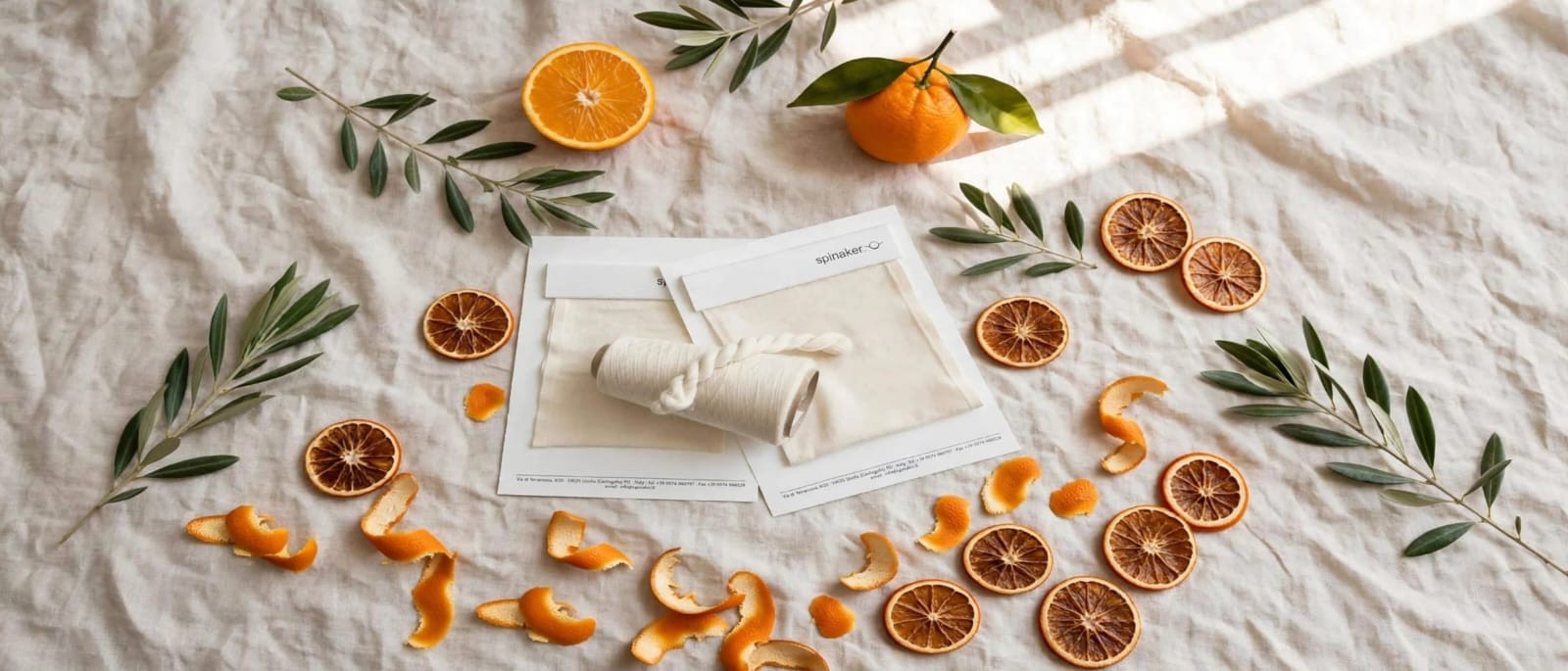
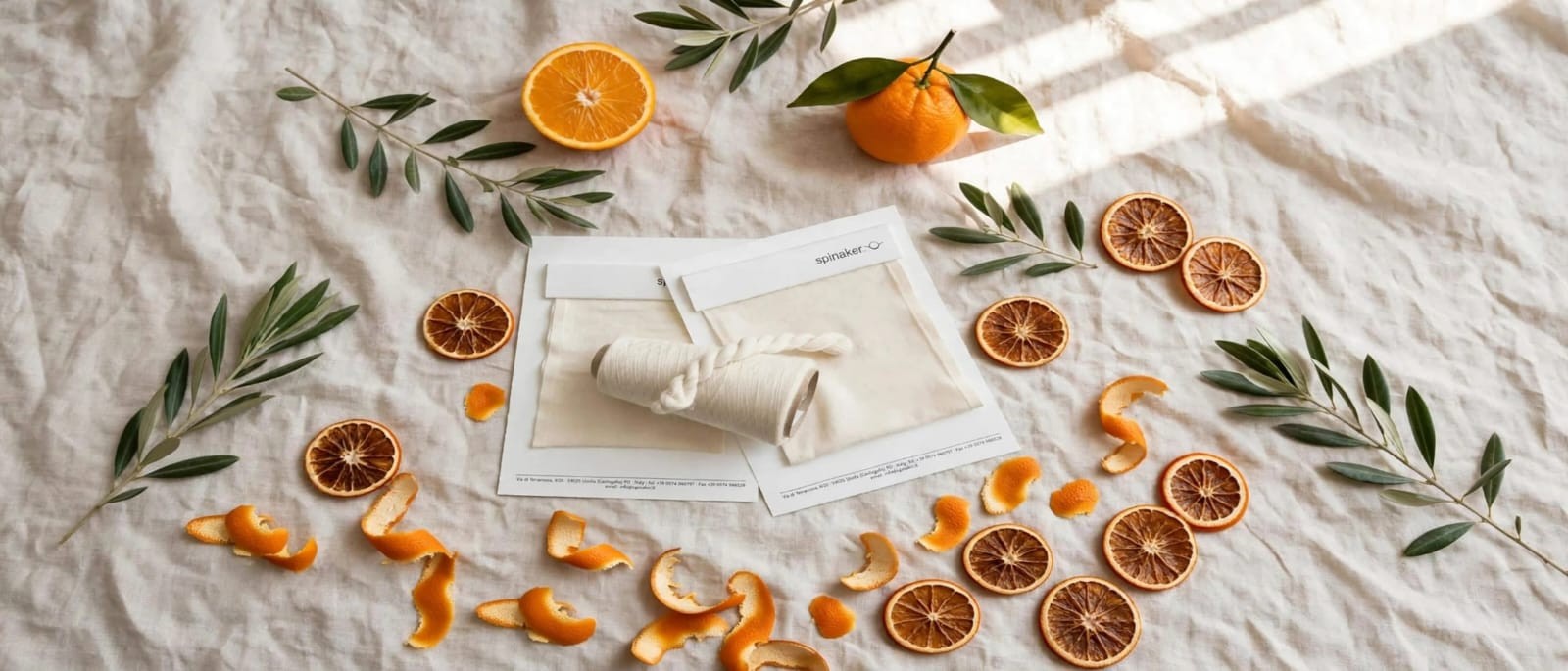
In Sicily, the citrus processing industry generates a significant volume of citrus pulp waste (known as pastazzo) every year, consisting of peels, pulp and seeds that are not intended for food consumption. Cellulose is extracted from this by-product and used to produce Orange Fiber, a man-made cellulosic fibre developed through a patented process in Italy. The aim of this process is to recover a secondary raw material and transform it into a textile fibre with consistent and reproducible functional properties.
The resulting fibre features a regular structure, good lustre, a soft and smooth handle, and excellent dye affinity, with dyeing behaviour similar to that of other man-made cellulosic fibres.
For spinning, Spinaker has developed an Nm 50,000 yarn made from a blend of Orange Fiber and cotton. The blend has been carefully formulated to ensure spinning continuity, yarn evenness and processing stability, while preserving the distinctive characteristics of Orange Fiber. The yarn is supplied in its greige form, with a natural ivory colour, wound onto cones. With its Nm 50,000 count, it falls within the fine-yarn range for knitting and weaving, making it suitable for lightweight fabrics with high breathability and excellent drape.
In terms of applications, the yarn is suitable for producing lightweight, open-structure fabrics and garments designed to be worn directly against the skin, particularly for Spring/Summer collections. The recommended processing method involves using medium-to-fine gauge machines, adjusting yarn tension according to the yarn count and controlling humidity levels in the spinning and weaving environment, as is standard practice for cellulosic fibres. Its washing and ironing behaviour is comparable to that of other cellulosic fibres, although care instructions should be verified on the finished garment according to the fabric construction.
Production takes place entirely at Spinaker’s facility in Usella, Cantagallo, Italy, where the blending, spinning process and finished product are all subject to quality control.
Upon request, the following are available: samples in the form of fabric swatches, a greige colour card, a complete technical data sheet including composition, yarn count, physical properties and processing guidelines, as well as documentation relating to the traceability of the raw materials used.